
The Vānaprastha Adventure, Installment 36
We have looked at what the vānaprastha āśrama is and what obstructions we might need to deal with. Here let’s look at some of the benefits of accepting the vānaprastha āśrama.
Having a realistic picture of what the future has in store
Let’s look first at one benefit of even having a vānaprastha āśrama and thinking about it. Acknowledging the importance of the vānaprastha āśrama—and thinking about the vānaprastha āśrama—keeps us mindful of the reality that’s in everyone’s future, including our own: the reality of death. In the Bhagavad-gītā Kṛṣṇa says that an essential part of cultivating knowledge is to be always mindful of the miseries of old age and death.1 Especially as we age, we can remember that death will come—soon—and that our real business is to get free from material entanglements and absorb ourselves in Kṛṣṇa consciousness. And so we need to move forward, spend our last years with this focus, and ultimately be ready to die.
Having this reality clearly in mind can help us shape how we live and what we do not only in old age but throughout our life. And this can help us be fully Kṛṣṇa conscious both in this life and at the time of our death.
Freedom from work
Among the benefits of actually adopting the vānaprastha āśrama, what first comes to my mind is freedom from working life, with its drudgery, its tensions and entanglements, the materialistic association it usually demands of us, and its daily claim on most of our waking hours. Now again our time becomes our own, to use for our own spiritual progress—and the service of our spiritual master and Kṛṣṇa.
A fresh new life
As our time becomes our own, we have the freedom to use it for whatever will best fulfill our highest hopes and most true desires. We have time for Kṛṣṇa kīrtana, for study of the Bhāgavatam, for bathing in the Ganges at Māyāpur. We have time for sādhu-saṅga, for learning and teaching, for spreading Kṛṣṇa consciousness in London or Paris or New York or Cairo or any town or village in the world. We’re no longer bound by obligations to a small domestic world. We can set out on the vānaprastha adventure.
Following in Śrīla Prabhupāda’s footsteps
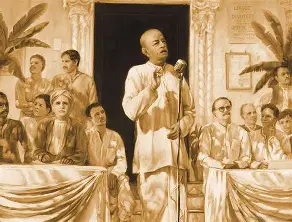
Śrīla Prabhupāda became a vānaprastha around 1951, near about the age of fifty-five. By adopting the vānaprastha āśrama, we follow in Śrīla Prabhupāda’s footsteps. And so, by following Śrīla Prabhupāda, we put theoretical knowledge into practice.
Detachment from matter, attachment to Kṛṣṇa
On this path, we gain greater control over our mind and senses, and we become increasingly detached from the material world and increasingly attached to Kṛṣṇa As we often heard from Śrīla Prabhupāda, Lord Caitanya came to this world to teach detachment, transcendental knowledge, and devotional service to him, the Supreme Personality of Godhead. As Sarvabhauma Bhaṭṭācārya writes:
vairāgya-vidyā-nija-bhakti-yoga- śikṣārtham ekaḥ puruṣaḥ purāṇaḥ
śrī-kṛṣṇa-caitanya-śarīra-dhārī kṛpāmbudhir yas tam ahaṁ prapadye
“Let me take shelter of the Supreme Personality of Godhead, Śrī Kṛṣṇa, who has descended in the form of Lord Caitanya Mahāprabhu to teach us real knowledge, his devotional service, and detachment from whatever does not foster Kṛṣṇa consciousness. He has descended because he is an ocean of transcendental mercy. Let me surrender unto his lotus feet.”2
Similarly, from the Śrīmad-Bhāgavatam (1.2.12) we hear that pure devotional service is supported by knowledge and detachment (jñāna-vairāgya yuktayā). And from the Bhagavad-gītā (15.3) we hear that we should cut ourselves free from the endless complexities of the material banyan tree by the weapon of determined detachment (asaṅga-śastreṇa dṛḍhena chittvā).
The vānaprastha āśrama helps foster that detachment. We become increasingly free from material designations—from “I” and “mine”—free from attachment to family ties, and free especially from woman and the shackles of sex. And as we progress we develop greater attachment to Kṛṣṇa.
In particular, the vānaprastha āśrama affords us the opportunity to focus on the five main limbs of devotional service:
sādhu-saṅga, nāma-kīrtana, bhāgavata-śravaṇa
mathurā-vāsa, śrī-mūrtira śraddhāyasevāna
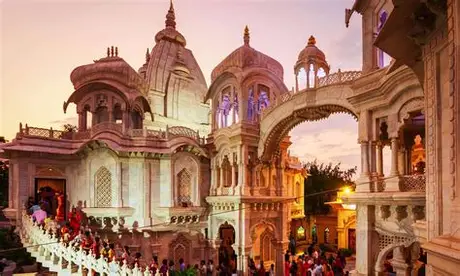
We get the opportunity to associate with like-minded devotees and with devotees more advanced, as Vidura met with Maitreya, and Parīkṣit with Śukadeva. We get to cleanse our hearts in kīrtana of Lord Kṛṣṇa’s holy names. We get to hear Śrīmad-Bhāgavatam and be enlightened by its message. We can live in such a holy place as Vṛndāvana or Māyāpur. And we can serve the Supreme Personality of Godhead, with faith and veneration, in his transcendental Deity form. From Caitanya-caritāmṛta (Madhya 22.128‒129) we hear that even slight engagement in these five main items of devotional service awakens our natural love for Kṛṣṇa.
By increasingly engaging ourselves in such a life of pure devotional service, we surely please our spiritual master and Kṛṣṇa. And instead of a life of hard work for small returns, we find ourselves on the path of unlimited spiritual happiness (brahma saukhyaṁ tv anantam).3
On this path, we can preach and serve, and ideally a man can move on towards the next āśrama, sannyāsa.
And whether in vānaprastha or in sannyāsa, we can take full shelter of Kṛṣṇa and prepare ourselves for our final time. No one can guarantee that our death will be natural or peaceful or easy. But if we are Kṛṣṇa conscious we can be assured, “When I leave I’ll proceed on the path back home, back to Godhead.”
These blessings are all advantages for us. But beyond this, adopting the vānaprastha āśrama enables us to benefit others as well.
Helping reestablish daiva-varṇāśrama
As we know, Śrīla Prabhupāda said that the unfulfilled part of his mission was to reestablish the Vedic social system, varṇāśrama dharma. And among the āśramas, vānaprastha has been a gap, a hole—the missing āśrama. By becoming vānaprasthas, one or two of us at a time, we help fill that social gap, making the vānaprastha āśrama visible and tangible and real, for the benefit of our own family and Society and the world, now and in the future.
Vānaprasthas for preaching and sevā
Vānaprasthas can also render immediate practical service to the Kṛṣṇa consciousness movement. The movement needs teachers, needs pūjārīs, needs mentors and guides, needs devotees who know how to do things. Who can cook the noon offering? Who can lead the design team for the new temple? Vānaprasthas can.
Brahmacārīs may be few. Gṛhasthas are busy earning a living, and these days if we want them to take up full-time service they most often expect stipends and salaries.
But vānaprasthas have their time free, they have decades of experience and expertise, and they can serve for the sake of serving, without expecting to be on a temple payroll. They can go anywhere to spread Kṛṣṇa consciousness. Vānaprasthas, therefore, are poised not only to refresh their own lives but to give life to the Kṛṣṇa consciousness movement.
As mentioned before, by adopting vānaprastha life we also get out of the way, letting the next generation take over. By handing over posts and responsibilities, we give younger devotees a chance to take over—and with youthful vigor and vision.
Moreover, by adopting vānaprastha life we set an example for our contemporaries—for other householders due (or overdue) for spiritual retirement—and we set an example for future generations, for our children and grandchildren: This is what old age is for.
Notes:
1 Janma-mṛtyu-jarā-vyādhi- duḥkha-doṣānudarśanam. (Gītā 13.9)
2 This verse, recorded in Śrī Kavi-karṇapūra’sCaitanya-candrodaya-nāṭaka (6.74), is quoted in Śrī Caitanya-caritāmṛta (Madhya 6.254).
3 Bhāgavatam 5.5.1.
This is part of a draft
This is an excerpt from a new book I have in the works—The Vānaprastha Adventure, a guide to retirement in spiritual life. The book should be published in early 2026. Meanwhile I’ll be posting my draft here, in installments.

You must be logged in to post a comment.