
The Vānaprastha Adventure, Installment 25
What are the obstacles one might face to accepting the life of a vānaprastha? I’ve thought of some and grouped them under these categories: attachment; illusion; concern for dependents and unfinished duties; inconvenience; inertia; bad advice; service to ISKCON; late starts; misgivings about boredom; invalidity; fear of the unknown; and lack of a clear path forward. Let’s look at them one by one.
Instructions on attachment by Prahlāda Mahārāja
The material attachments that may naturally develop in householder life are described by Prahlāda Mahārāja in Śrīmad-Bhāgavatam (7.6.9‒13). Of course, not all of his description may pertain to us. But some of it certainly may. And we can consider for ourselves how much. Because his description is so vivid and so clearly makes its points, I quote it here in full.
ko gṛheṣu pumān saktam
ātmānam ajitendriyaḥ
sneha-pāśair dṛḍhair baddham
utsaheta vimocitum
What person too attached to household life due to being unable to control his senses can liberate himself? An attached householder is bound very strongly by ropes of affection for his family [wife, children, and other relatives].
konvartha-tṛṣṇāṁ visṛjet
prāṇebhyo ’pi ya īpsitaḥ
yaṁ krīṇāty asubhiḥ preṣṭhais
taskaraḥsevāko vaṇik
Money is so dear that one conceives of money as being sweeter than honey. Therefore, who can give up the desire to accumulate money, especially in household life? Thieves, professional servants [soldiers], and merchants try to acquire money even by risking their very dear lives.
kathaṁ priyāyā anukampitāyāḥ
saṅgaṁ rahasyaṁ rucirāṁś ca mantrān
suhṛtsu tat-sneha-sitaḥ śiśūnāṁ
kalākṣarāṇām anurakta-cittaḥ
How can a person who is most affectionate to his family, the core of his heart being always filled with their pictures, give up their association? Specifically, a wife is always very kind and sympathetic and always pleases her husband in a solitary place. Who could give up the association of such a dear and affectionate wife? Small children talk in broken language, very pleasing to hear, and their affectionate father always thinks of their sweet words. How could he give up their association?
putrān smaraṁs tā duhitṝr hṛdayyā
bhrātṝn svasṝr vā pitarau ca dīnau
gṛhān manojñoru-paricchadāṁś ca
vṛttīś ca kulyāḥ paśu-bhṛtya-vargān
One’s elderly parents and one’s sons and daughters are also very dear. A daughter is especially dear to her father, and while living at her husband’s house she is always in his mind. Who could give up that association? Aside from this, in household affairs there are many decorated items of household furniture, and there are also animals and servants. Who could give up such comforts?
tyajeta kośas-kṛd ivehamānaḥ
karmāṇi lobhād avitṛpta-kāmaḥ
aupasthya-jaihvaṁ bahu-manyamānaḥ
kathaṁ virajyeta duranta-mohaḥ
The attached householder is like a silkworm, which weaves a cocoon in which it becomes imprisoned, unable to get out. Simply for the satisfaction of two important senses—the genitals and the tongue—one is bound by material conditions. How can one escape?
Śrīla Prabhupāda’s comments
Śrīla Prabhupāda’s purport for the first of these texts (text 9) offers further insights and understandings. First he explains that the real purpose of human life is to practice devotional service, revive our eternal relationship with Kṛṣṇa, and finally give up all other duties and surrender to Kṛṣṇa. Our real duty, Śrīla Prabhupāda says, is to get free from the cycle of birth, death, old age, and disease. And for this “one must first be liberated from material bondage, and especially from household life.” Household life, he says, “is actually a kind of license for a materially attached person by which to enjoy sense gratification under regulative principles. Otherwise there is no need of entering household life.”
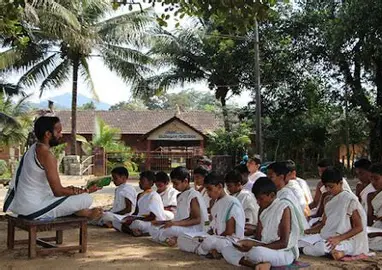
For the sake of freedom from household life, Śrīla Prabhupāda next explains, earlier in life—before getting married—one should be properly trained as a brahmacārī, living in the gurukula under the care of the guru, and learn how to control one’s senses and sacrifice everything for the guru. Then, “When he is fully trained, if he likes he is allowed to marry. Thus he is not an ordinary gṛhastha who has learned only how to satisfy his senses.”
Śrīla Prabhupāda continues: “A trained gṛhastha can gradually give up household life and go to the forest to become increasingly enlightened in spiritual life and at last take sannyāsa. . . . However, if one prefers to remain in the dark well of household life because of uncontrolled senses, he becomes increasingly entangled by ropes of affection for his wife, children, servants, house, money and so on. Such a person cannot attain liberation from material bondage. Therefore children should be taught from the very beginning of life to be first-class brahmacārīs. Then it will be possible for them to give up household life in the future.”
If we haven’t been trained
But what if we haven’t been trained as brahmacārīs or we still don’t seem to have the needed strength? Then getting free will be more difficult. As Śrīla Prabhupāda explains, “A man becomes increasingly entangled in household affairs, so much so that leaving them becomes almost impossible.”1 But note the almost. Once one has fallen into the dark well of family attachment, “to get out is extremely difficult unless he is helped by a strong person, the spiritual master, who helps the fallen person with the strong rope of spiritual instructions. A fallen person should take advantage of this rope, and then the spiritual master, or the Supreme Personality of Godhead, Kṛṣṇa, will take him out of the dark well.”2
With the help of our spiritual master, we can turn aside from the last remnants of sinful life, engage instead in activities that are uplifting, be freed from illusion and its dualities like desire and hate, and so engage in devotional service to Kṛṣṇa with determination.3 Armed with the weapon of resolute detachment, we can cut free from all the entanglements of material existence (asaṅga-śastreṇa dṛḍhena chittvā) and finally, fully surrendered to Kṛṣṇa, go back to his eternal abode, never to return.4
The strongest of all attachments, of course, is attachment to sex. Even in old age, when sex is more pitiable than pleasurable, one may still be attached to it.
As we find in Śrīmad-Bhāgavatam (9.19.16):
yā dustyajā durmatibhir
jīryato yā na jīryate
tāṁ tṛṣṇāṁ duḥkha-nivahāṁ
śarma-kāmo drutaṁ tyajet
“For those who are too attached to material enjoyment, sense gratification is very difficult to give up. Even when one is an invalid because of old age, one cannot give up such desires for sense gratification. Therefore, one who actually desires happiness must give up such unsatisfied desires, which are the cause of all tribulations.”
Śrīla Prabhupāda comments: “We have actually seen, especially in the Western countries, that men who have reached more than eighty years of age still go to nightclubs and pay heavy fees to drink wine and associate with women. Although such men are too old to enjoy anything, their desires have not ceased. Time deteriorates even the body itself, which is the medium for all sensual satisfaction, but even when a man becomes old and invalid, his desires are strong enough to dictate that he go here and there to satisfy the desires of his senses. Therefore, by the practice of bhakti-yoga, one should give up his lusty desires.”
Instructions from Nārada
A man not running here and there to enjoy with women may still be attached to the feminine association he gets from his wife. As Nārada Muni tells King Yudhiṣṭhira:5
jahyād yad-arthe svān prāṇān
hanyād vā pitaraṁ gurum
tasyāṁ svatvaṁ striyāṁ jahyād
yas tena hy ajito jitaḥ
“One so seriously considers one’s wife to be his own that he sometimes kills himself for her or kills others, including even his parents or his spiritual master or teacher. Therefore if one can give up his attachment to such a wife, he conquers the Supreme Personality of Godhead, who is never conquered by anyone.”
kṛmi-viḍ-bhasma-niṣṭhāntaṁ
kvedaṁ tucchaṁ kalevaram
kva tadīya-ratir bhāryā
kvāyam ātmā nabhaś-chadiḥ
“Through proper deliberation, one should give up attraction to his wife’s body because that body will ultimately be transformed into small insects, stool or ashes. What is the value of this insignificant body? How much greater is the Supreme Being, who is all-pervading like the sky?”
These are instructions Nārada Muni gives specifically for householders. So we should cultivate such understanding and detachment even while in householder life. And finally, with strength gained from the instructions of the spiritual master, we should give up householder life altogether and enter the vānaprastha āśrama.
———-
Our discussion of obstacles will continue in the next installments.
Notes:
1 Bhāgavatam 7.6.11‒13, purport.
2 Bhāgavatam 7.6.11‒13, purport. (emphasis supplied)
3 Gītā 7.28.
4Gītā15.3‒4.
5 Bhāgavatam 7.14.12‒13.
This is part of a draft
This is an excerpt from a new book I have in the works—The Vānaprastha Adventure, a guide to retirement in spiritual life. While I’m working on it, I’ll be posting my draft here, in installments. I invite your comments, questions, and suggestions.

You must be logged in to post a comment.