
The Vānaprastha Adventure, Installment 26

Attachment and illusion go together. And they spill over into other categories. Still, we can analyze these items separately.
The fundamental illusion, of course, is the bodily conception of life, in which one thinks, “I am this body, and this is mine.” As stated by Lord Ṛṣabhadeva (and often quoted by Śrīla Prabhupāda):
puṁsaḥ striyā mithunī-bhāvam etaṁ
tayor mitho hṛdaya-granthim āhuḥ
ato gṛha-kṣetra-sutāpta-vittair
janasya moho ’yam ahaṁ mameti“The attraction between male and female is the basic principle of material existence. On the basis of this misconception, which ties together the hearts of the male and female, one becomes attracted to his body, home, property, children, relatives, and wealth. In this way one increases life’s illusions and thinks in terms of ‘I and mine.’ ”1
Commenting on this verse, Śrīla Prabhupāda says, “Sometimes, even after renunciation, one becomes attached to a temple or to the few things that constitute the property of a sannyāsī, but such attachment is not as strong as family attachment. The attachment to the family is the strongest illusion.”
Śrīla Prabhupāda has spoken about this so extensively and so often that I won’t elaborate.
King Yayāti’s life of enjoyment
Another persistent illusion is the illusion that we can still enjoy happiness by making our senses feel good. Even though we may theoretically know better, our knowledge may still be clouded by this illusion (and the attachments that go with it).
We can see this illusion vividly in the life of King Yayāti, whose history is told in the Ninth Canto of Śrīmad-Bhāgavatam (chapters 18 and 19). That history is worth summarizing here.
Once Devayānī, the daughter of Śukrācārya, was bathing with many other girls, including her friend Śarmiṣṭhā, when Lord Śiva happened by on his bull. The girls quickly dressed themselves, but Śarmiṣṭhā mistakenly put on Devayānī’s clothes. This led to an argument, in which Śarmiṣṭhā finally threw Devayānī naked into a well.
By chance King Yayāti came to that well to drink water, and seeing Devayānī he extended his hand to her and rescued her. The king and the girl naturally became attracted to one another, and with the permission of Śukrācārya they married, with Śarmiṣṭhā and the other girlfriends becoming Devayānī’s maidservants. When Śukrācārya gave permission for the marriage, however, he warned Yayāti never to have sexual relations with Śarmiṣṭhā.
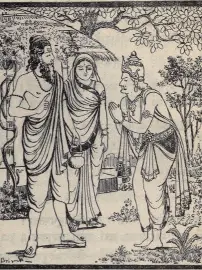
In the course of time, when Devayānī became pregnant, Śarmiṣṭhā too wanted a son, Yayāti felt obliged to fulfill her desire, and so he did. But Śukrācārya, upon coming to know, cursed Yayāti to become old and invalid. When Yayāti, however, pleaded for mercy—“My lust to enjoy with your daughter is still with me”—Sukrākcārya agreed that Yayāti could regain his youth by transferring his old age and invalidity to some young man. Yayāti’s son Puru agreed to accept the curse, and so the lusty Yayāti, although a devotee of the Lord, enjoyed material possessions and sex with Devayānī for one thousand years.
King Yayāti and his wife attain liberation
Finally, however, Yayāti became disgusted with this life of supposed enjoyment. Understanding that the consequences of such a life were against his own best interests, he told his wife an allegorical story of a lusty he-goat and she-goat whose life together mirrored theirs.
Explaining the allegory, Yayāti said to his wife, “I am exactly like that he-goat, for I am so poor in intelligence that I am captivated by your beauty and have forgotten the real task of self-realization. A person victimized by lusty desires cannot satisfy his mind even if he has enough of everything in this world. Nothing can satisfy him. The desires of a lusty person can never be calmed by enjoyment, just as a fire cannot be put out with butter, which instead excites the fire more and more.”2
For those too attached to material enjoyment, Yayāti said, sense gratification is difficult to give up, even in old age. But one who actually desires happiness must give up his unsatisfied desires, which cause all tribulations.
Yayāti said, “I have spent a full one thousand years enjoying sense gratification, yet my desire to enjoy such pleasure increases daily.”3 He therefore gave up those desires and fixed his mind on the Supreme Personality of Godhead. Yayāti returned Puru’s youth, accepted old age, divided the kingdom among his sons, and retired to the forest.
The Bhāgavatam says, “Having enjoyed sense gratification for many, many years, Yayāti was accustomed to it, but he gave it up entirely in a moment, just as a bird flies away from the nest as soon as its wings have grown.”4 Thus the king surrendered to the Supreme Personality of Godhead and became an eternal associate of the Lord.
By hearing the story of the he-goat and she-goat, Devayānī too awakened to self-realization. The Bhāgavatam says, “She understood that the materialistic association of husband, friends, and relatives is like the association in a hotel full of tourists. The relationships of society, friendship, and love are created by the māyā of the Supreme Personality of Godhead, exactly as in a dream. By the grace of Kṛṣṇa, Devayānī gave up her imaginary position in the material world. Completely fixing her mind upon Kṛṣṇa, she achieved liberation from the gross and subtle bodies.”5
Householders (and everyone else) can benefit from remembering this history from the Bhāgavatam.
If unlike Yayāti and Devayānī we wanted to marry but a suitable opportunity never arose, in our fifties or later we may still cherish the illusion that we will be happy if only we can find the right marital partner. Better for us to accept that in this lifetime gṛhastha life is not providentially ordained and move on.
———-
Our discussion of obstacles will continue in the next installments.
Notes:
1 Bhāgavatam 5.5.8.
2 Bhāgavatam 9.19.12‒14.
3 Bhāgavatam 9.19.18.
4 Bhāgavatam 9.19.24.
5 Bhāgavatam 9.19.27‒28.
This is part of a draft
This is an excerpt from a new book I have in the works—The Vānaprastha Adventure, a guide to retirement in spiritual life. While I’m working on it, I’ll be posting my draft here, in installments. I invite your comments, questions, and suggestions.

You must be logged in to post a comment.