
The Vānaprastha Adventure, Installment 27

Our wife, children, and other dependents are naturally objects of our care and concern. But once we age past the time for householder life, we are advised to awaken to the sense that they are ultimately dependent not upon us but upon Kṛṣṇa. Though I may think, “Without me, what will happen to them?” my duty now is to move towards detachment, understanding that ultimately everything is in Kṛṣṇa’s hands.
The Bhāgavatam (11.17.56) speaks of the kind of man we don’t want to be—a man whose mind is attached to his home and household life, a man troubled by wants about money and children, a man dull and poor-minded, and under the sway of his woman. He thinks in terms of “I” and “mine” and so is bound by illusion. Such a man thinks:
aho me pitarau vṛddhau
bhāryā bālātmajātmajāḥ
anāthā mām ṛte dīnāḥ
kathaṁ jīvanti duḥkhitāḥ
“O my poor elderly parents, and my wife with a mere infant in her arms, and my other young children! Without me they have no one to protect them and will suffer unbearably. How can my poor relatives possibly live without me?”1
In this way, the Bhāgavatam says, the foolish, dissatisfied man whose heart is overcome by desires for his family dies thinking of them constantly and enters the darkness of ignorance.2
We might feel that the Bhāgavatam is here being harsh. But the Bhāgavatam is speaking the truth. Were I to die today, somehow my wife and parents and children would go on living. But if I die in illusion, thinking that their lives depend on me, and if I die thinking of them rather than of Kṛṣṇa, that is my misfortune.
Examples from the Bhāgavatam
We can recall the example of King Yudhiṣṭhira’s being chastised by Nārada for thinking Dhṛtarāṣṭra and Gāndhārī dependent on him. When Dhṛtarāṣṭra, by the grace of Vidura, realized the urgent need for detachment and self-realization and suddenly went off to the Himalayas, followed by Gāndhārī, Yudhiṣṭhira Mahārāja was afflicted with concern for them. But Nārada advised Yudhiṣṭhira that there was no need to lament. Nārada said, “As by the sweet will of a player some playthings are set up and dispersed, so by the supreme will of the Lord men are brought together and separated.”3 And so, Nārada said, “Give up your anxiety due to ignorance of the self. You are now thinking of how they—helpless poor creatures!—will exist without you.”4
Śrīla Prabhupāda comments: “When we think of our kith and kin as being helpless and dependent on us, it is all due to ignorance. Every living creature is allowed all protection by the order of the Supreme Lord in terms of each one’s acquired position in the world. The Lord is known as bhūta-bhṛt, one who gives protection to all living beings. One should discharge his duties only, for no one but the Supreme Lord can give protection to anyone else.”
Nārada said: “Your own body is under the control of eternal time. That body is already in the jaws of the serpent. How then can it protect others?5
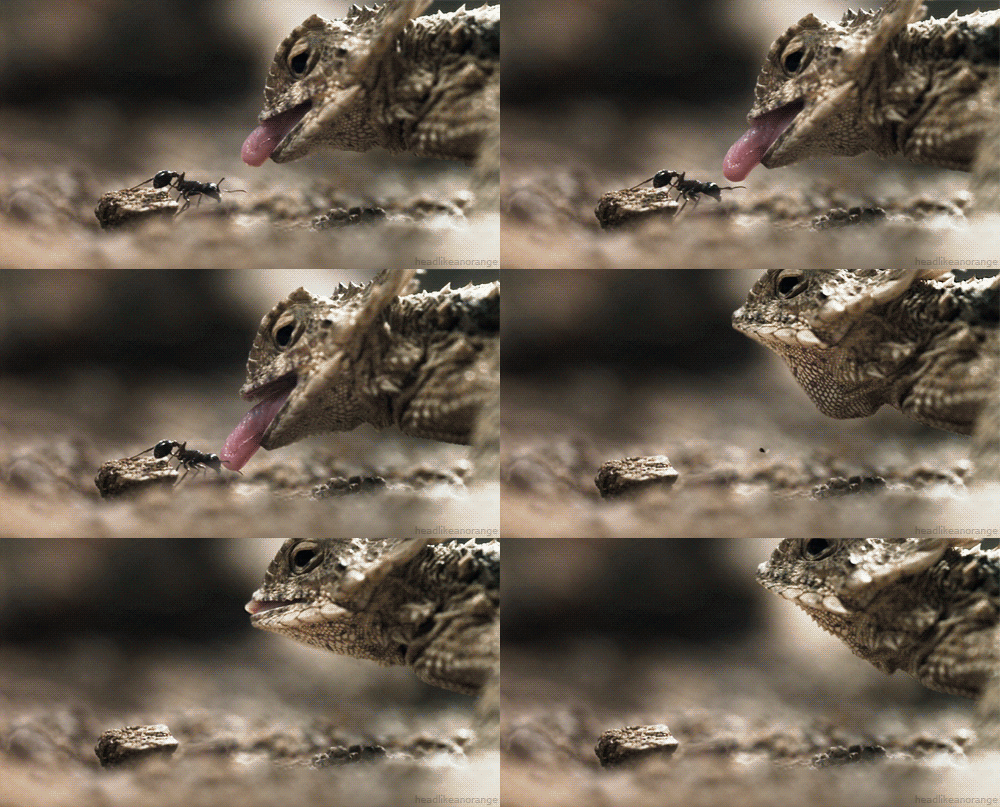
Śrīla Prabhupāda cites the example of Śrīdhara Svāmī.6 Śrīdhara Svāmī, a great devotee, was thinking of leaving home, taking sannyāsa. But meanwhile his wife became pregnant. Then he thought, “If I take sannyāsa now, what will people say?” So he waited until the child was born—and then the mother died. Then he thought, “I do not know what Kṛṣṇa desires. Who will take care of this motherless child?” While he was thinking in this way, a newborn lizard dropped before him, and at once a small ant came before the lizard’s mouth, and the lizard ate it. Then Śrīdhara Svāmī thought, “Every arrangement is there. Why am I thinking of this and that?” And so Śrīdhara Svāmī left home. Śrīla Prabhupāda comments, “Actually, that is the position. The actual care is taken by Kṛṣṇa.” And Śrīla Prabhupāda quotes from the Kaṭha Upaniṣad (2.2.13), eko yo bahūnāṁ vidadhāti kāmān: “The one supreme eternal conscious being maintains the innumerable others.”
Śrīla Prabhupāda’s own experience
Śrīla Prabhupāda has also cited the example of his own life.7 “When I was householder, several times there was indication given by my Guru Mahārāja that I should give up my family life and become a sannyāsī and preach this Kṛṣṇa consciousness movement.” In several ways, Śrīla Prabhupāda said, there were hints from his spiritual master. “But still I was not willing. I was thinking, ‘If I go away, then my family—my sons, my daughters—they will suffer.’ But actually, I have left my family connection in 1950. Actually ’54, but introductory in ’50. For the last twenty years. But they are living, I am living. They are not dying in my absence, and I am not suffering without being in my family.” Therefore, Śrīla Prabhupāda concluded, “according to the Vedic system, at a certain age it is indicated that one should retire from family life.”
Of course, Śrīla Prabhupāda has been speaking above of taking sannyāsa, and we are speaking only of adopting the life of a vānaprastha. Still, we may think, “I have unfinished duties. And how will things go on? What about my parents? What about my children’s education and their marriage?”
But I am not going to be around forever either. So I need to adopt a deeper and broader outlook and accept a deeper and broader sense of responsibility. This also is a part—the last part—of family life.

At a certain time, we have to close the office, close the store. Śrīla Prabhupāda writes, “According to the varṇāśrama principle, it is compulsory that one retire after the age of fifty, without considering other circumstances. Business offices close at a fixed hour no matter what balance of work remains. Similarly, after the age of fifty one must retire from the active, external life and devote oneself to the introspective cultivation of the human spirit.”8
———-
Our discussion of obstacles will continue in the next installments.
Notes:
1Bhāgavatam 11.17.57.
2Bhāgavatam 11.17.58. See also the final thoughts of King Purañjana (Bhāgavatam 4.28.16‒22).
3Bhāgavatam 1.13.43.
4Bhāgavatam 1.13.45.
5Bhāgavatam 1.13.46.
6 Conversation, February 6, 1974, Vṛndāvan.
7 Bhāgavatam class, September 12, 1969, Tittenhurst Park, UK.
8Light of the Bhāgavata, verse 37, purport. See also Śrīla Prabhupāda’s comments on “unfinished duties” above at the end of the section “Sending our children to college.”
This is part of a draft
This is an excerpt from a new book I have in the works—The Vānaprastha Adventure, a guide to retirement in spiritual life. While I’m working on it, I’ll be posting my draft here, in installments. I invite your comments, questions, and suggestions.

You must be logged in to post a comment.