
The Vānaprastha Adventure, Installment 28
Having a good, steady arrangement for life at home is helpful for health and sādhana. Ideally, everything is in its place, meals are on time and agreeable, our schedule is the same every day.
In contrast, when we travel we have to put up with uncertainty and irregularity. Traveling can be troublesome and wearisome, especially in old age. And who wants weariness and trouble?
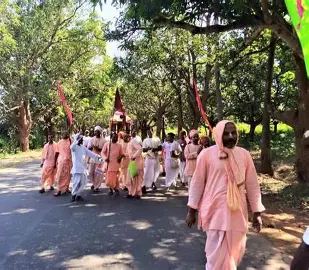
But, first of all, our modern idea of travel is sometimes excessive. As vānaprasthas, we need not get on an airplane every few days and travel to a new place. Also, in former times “travel” mainly meant travel on foot. By this sort of simple travel, a pilgrim developed a peaceful mind and was literally more “grounded.” (Even today, the ISKCON Padayātrā offers opportunities for this sort of travel.) Or one may travel by modern means but at a moderate pace.
And, for that matter, a vānaprastha need not travel. A wife, especially, may continue to live mainly at home. And for those who prefer, one mode of vānaprastha life is to stay steadily in one holy place.
Then again, our life at home may fall something short of the ideal. We may stay home and overeat or oversleep, and even at home our schedules may be erratic. Or with all the comfort and convenience, life at home may come to feel simply dull.
Giving up the life of a crane
Describing the rainy season, the Bhāgavatam (10.20.22) analogously speaks of cranes. “A crane stands on the edge of a pond that is always disturbed by flowing water, mud, and stones. The crane is like a householder who is disturbed in the shelter of his home but who, because of too much attachment, does not want to change his position.”1
Commenting on this verse, Śrīla Prabhupāda says, “Too much attachment for hearth and home is never recommended by a self-realized soul.”2 But by progressing through the four āśramas, Śrīla Prabhupāda says, “one accepts a gradual process of spiritual activities for the ultimate goal of liberation.”
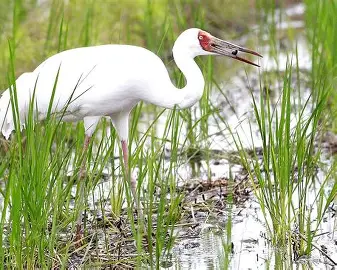
But: “Unfortunately, for want of sufficient culture of the human spirit, no one wants to give up the householder life, even though it is full of pinpricks and mud. And those who are too attached amidst the pinpricks of muddy householder life are compared to the cranes that stand on the bank of the river for some sense enjoyment despite all the inconveniences there. We should always remember that the society, friendship, and love we are supposed to enjoy in family life are only shadowy representations of the real society, friendship, and love reciprocated in the kingdom of God. There is no reality in the conditioned life of material existence, but because of our ignorance we are attached to the mirage. The idea of society, friendship, and love is not at all false, but the place where we search for it is false. We have to give up this false position and rise to the reality. That should be the aim of life, and that is the result of cultivating the human spirit.”3
Accepting trouble for a higher cause
The inconveniences of vānaprastha life are small compared to what Śrīla Prabhupāda sometimes called the “inconveniences” of birth, death, old age, and disease. And by leaving family life one makes progress on the path towards happiness that is eternal and unlimited. One is therefore advised to voluntarily accept whatever inconveniences vānaprastha life may entail.
Śrīla Prabhupāda once said:
Just like a man is very happy in his family life. He has good house, good wife, good children and good bank balance, enjoying life. But śāstra says, “Now you are fifty years old, you must get out.” So he has to get out. He cannot say that “I am so happy in my family life. My wife is so nice. My children are so obedient. I have got nice money, income. Why shall I go out?”
Śāstra says, “No. Vanaṁ vrajet.” Vrajet means “must.” You must go to the forest. But if you disobey, then you will be in trouble. Just like you disobey the laws, you will be in trouble. So this is called tapasya. I do not like to go out of my home, very comfortable home, happy home, but śāstra says, “You must.”
So I have to accept inconveniences. If I leave my home, comfortable home, I do not know where to live, how to eat, where to stay. These are experienced. When we took sannyāsa, in the beginning we thought like that. But by the grace of God, Kṛṣṇa, we are not uncomfortable. . . . We left only three or four children. Now we have got hundreds of children—without any botheration of wife. [laughter] And they are so obedient and so beautiful, so nice, that I could not expect [this] even [from] the children which I begot at home.4
And so, although vānaprastha life may sometimes be troublesome, we may simply accept the trouble (as Śrīla Prabhupāda did) for the sake of a higher cause.
Writing from his own realization, Śrīla Prabhupāda said about saintly persons, “They are sincere friends to all living entities, and at the risk of great personal inconvenience they are always engaged in the service of the Lord for the good of all people.”5
———-
Our discussion of obstacles will continue in the next installments.
Notes:
1 Light of the Bhāgavata, verse 19. The verse numbers in the book differ from those in the BBT edition of the Bhāgavatam.
2 Light of the Bhāgavata, verse 19, commentary.
3 Light of the Bhāgavata, verse 19, commentary.
4 September 16, 1969, London.
5 Bhāgavatam 1.1.4, purport.
This is part of a draft
This is an excerpt from a new book I have in the works—The Vānaprastha Adventure, a guide to retirement in spiritual life. While I’m working on it, I’ll be posting my draft here, in installments. I invite your comments, questions, and suggestions.

You must be logged in to post a comment.