
The Vānaprastha Adventure, Installment 23
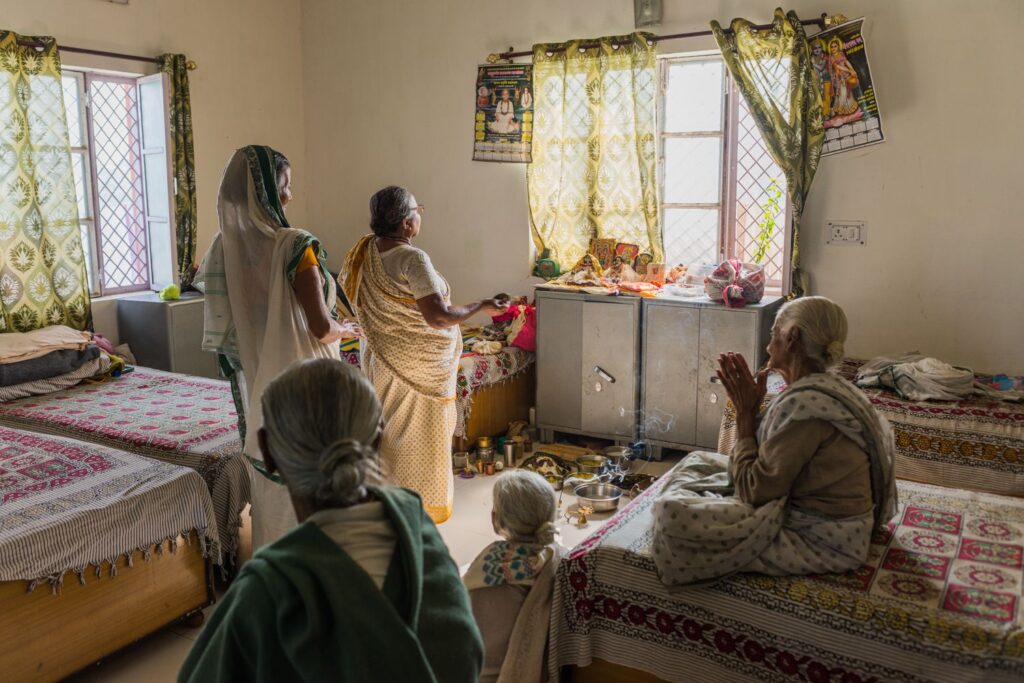
We’ve talked a lot about the role of men as it relates to the vānaprastha āśrama. What about women?
First: The goal for women is the same as that for men—to become fully Kṛṣṇa conscious, fully engaged in devotional service, and at the end go back home, back to Godhead. And as Kṛṣṇa says in the Bhagavad-gītā (9.32), this is a perfection both men and women can achieve.
But according to Vedic principles, as Śrīla Prabhupāda taught them, the social role in which women should do this differs from that of men. In the mature stage, men should strive to be free and independent from family, wife, home, and so on, as Śrīla Prabhupāda showed by his ideal example when he accepted sannyāsa and set off alone from India for New York. Women, however, will be better situated when they serve under care and protection, as shown by the ideal examples of saintly devotees like Devahūti, Kuntī, Arci Devī (the wife of Mahārāja Pṛthu) and (in Caitanya-līlā) Śacī Devī, Viṣṇupriyā Devī, Sītā Ṭhākurāṇī, and Jāhnavī Devī.
According to the Vedic social system, Śrīla Prabhupāda explains, for a man there are four stages of life—brahmacārya, gṛhastha, vānaprastha, and sannyāsa—and for a woman there are three: In her childhood she should live under the protection of her father, in her youth under the protection of her husband, and in old age under the protection of her sons. She should never live independently. This is the direction given in the Manu-saṁhitā.1
Women do not take sannyāsa, and traditionally women did not go to the place of the guru for brahmacārī training. So Śrīla Bhaktivinoda Ṭhākura writes that women are allowed to enter the gṛhastha and vānaprastha āśramas only.2
Continuing to serve
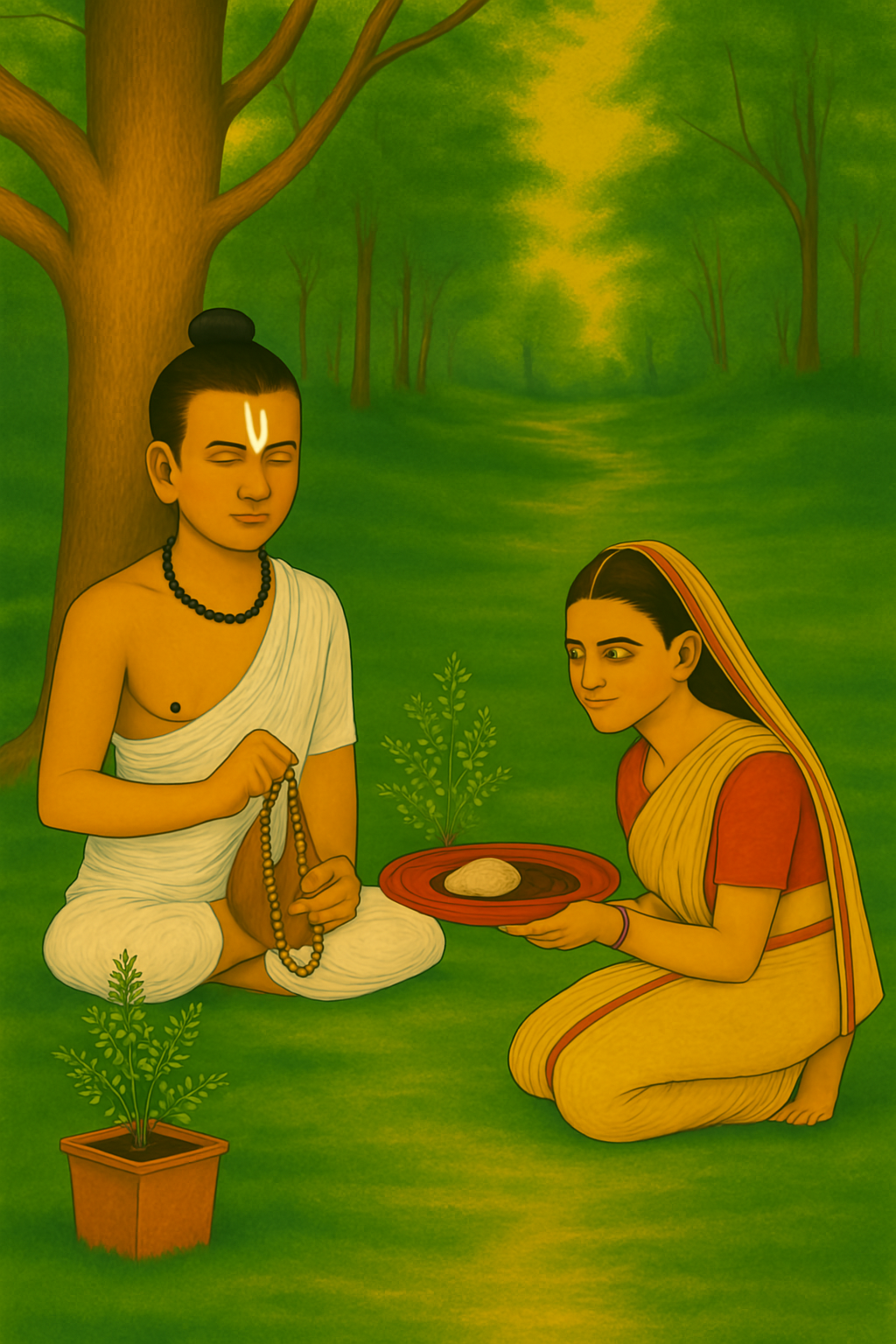
In the gṛhastha āśrama a Kṛṣṇa conscious wife offers her husband spiritual service and encouragement, and one great service a woman can do, when the time comes, is to support her husband’s decision to adopt the vānaprastha āśrama, whether she stays at home or travels with him. Sometimes a wife more detached than her husband may encourage progress from family life to the vānaprastha āśrama. In this way too a woman can render a great service.
As mentioned earlier, in former days when the husband entered the forest as a vānaprastha his wife could stay with him as a voluntary assistant. Śrīla Prabhupāda writes:
“The chaste wife’s duty is to keep her husband pleased in householder life in all respects, and when the husband retires from family life, she is to go to the forest and adopt the life of vānaprastha, or vana-vāsī. At that time the wife is to follow her husband and take care of him, just as she took care of him in householder life.”3
Living austerely
In the forest the vānaprastha man would live a life of strict austerity, and so too would his wife. She would accept only the bare necessities of life and minimize her eating and sleeping, and there would be no question of sex. She would give up all luxurious habits and not even dress nicely or comb her hair, which would thus become tangled in knots. So the wife would no longer be attractive to the husband, and she herself would no longer be agitated by sexual impulses. “In this way,” Śrīla Prabhupāda writes, “both husband and wife can advance in spiritual consciousness. This advanced stage is called the paramahaṁsa stage, and once it is obtained both husband and wife can be actually liberated from bodily consciousness.”4
In the purport where Śrīla Prabhupāda describes all this, he is writing about Vaidarbhī—King Purañjana reborn as a king’s daughter. Yet when we read the purport, Śrīla Prabhupāda seems to be prescribing these same principles for women in vānaprastha life even today.
I won’t venture to tell women in this stage precisely how they should live. But clearly for women life in the vānaprastha stage is a far cry from life in the gṛhastha āśrama. This is not a time of youth and beauty, and it is pathetic to see modern women trying to fake it, doing themselves up and looking like painted gargoyles.
When the husband takes sannyāsa
In any case, whether husband and wife live in the forest or elsewhere, eventually the husband may take sannyāsa. Then:
“When the husband takes the renounced order of life, namely sannyāsa, the wife is to return home and become a saintly woman, setting an example for her children and daughters-in-law and showing them how to live a life of austerity.”5
The highest ideal was shown by Śrīmatī Viṣṇupriyā Devī:
“When Caitanya Mahāprabhu took sannyāsa, His wife, Viṣṇupriyādevī, although only sixteen years old, also took the vow of austerity due to her husband’s leaving home. She chanted her beads, and after finishing one round, she collected one grain of rice. In this way, as many rounds as she chanted, she would receive the same number of rice grains and then cook them and so take prasāda. This is called austerity.”6
Of course, the exalted life of Śrīmatī Viṣṇupriyā is not to be imitated. But her example of living austerely and chanting the holy name can be followed. Śrīla Prabhupāda writes: “Even today in India, widows or women whose husbands have taken sannyāsa follow the principles of austerity, even though they live with their children.”7
I have seen personally how an elderly Indian widow may live at home with her family but her real business is bhajana—chanting of the holy name, reading of scripture, and worship of the Deity. In this way she sets an ideal example for the entire family, reminding them of the real purpose of life.
Instructions for widows
In correspondence with women disciples, Śrīla Prabhupāda gave further instructions about how a widowed woman should live. “She must not be attractive at all. A widow is forbidden to use ornaments, nice sari, decoration, combing the hair nicely. These are forbidden for the women [sic] who is not with husband.”8
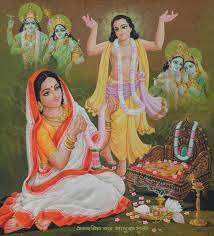
Śrīla Prabhupāda wrote to one female disciple, still young, whose husband had left that she should live like a chaste Hindu widow. He wrote, “There are many ideal young Hindu widows who do not dress nicely at all, do not comb the hair, and who take bath three times daily in the Ganges, wear white sari and are engaged 24 hours a day in chanting Hare Krsna Mantra.” Śrīla Prabhupāda then cited the ideal example of Viṣṇupriyā Devī, as described above. Although Viṣṇupriyā Devī is the goddess of fortune, he said, “Just see how much austerity she underwent!” Śrīla Prabhupāda advised, “I think you should follow the footsteps of Srimati Visnupriya Devi.”
Śrīla Prabhupāda further instructed, “You have good writing capacity, and good artistic ability. Now devote your life to chanting Hare Krsna and if possible write articles on Krsna Consciousness, as many as possible with your own paintings and send it for publication to BTG.” In summary: “Engage your life fully for Krsna Consciousness. Only chant Hare Krsna Mantra day and night, read books[,] and expressing the philosophy in your own words write articles for publishing in BTG.” Śrīla Prabhupāda concluded, “Take Krsna as your Supreme Protector and Krsna will help you in all respects. Practice this prescription and you will be happy eternally.”9
When Yamunā Devī with other women close to her wanted to start a women’s āśrama, Śrīla Prabhupāda expressed reservations about women living independently,10 but nonetheless he gave his consent. As for engagement, Śrīla Prabhupāda wrote, “Your engagement should be chanting and worship of the Deity.”11
He advised against their doing large-scale cow protection. “Manage a small asram, but don’t try bigger scale, then you require the help of men. Don’t try manual exertion, then again there is mixture [of women and men] and that is not desired. Simply keep yourself aloof from men—chanting, many more times as possible, read books, worship the deity.”12
He also counseled, “If you produce milk, you should not drink milk very much. Rather, you should save it and convert it into ghee and then sell it to the householders and centers and thus maintain your asrama. The excess quantity of ghee may be exchanged by trade. Kirtana is our first duty. The Deity worship should be simple and the eating should be as meager as possible.”13
Continuing along the same lines, Śrīla Prabhupāda wrote,
“Chant 24 hours a day and don’t dress nicely to attract men. It is better that you don’t make a large program. Remain a humble program. In bhakti there is no grotesque program.14 A humble program is better. We are doing all these grotesque programs to allure the masses. My Guru Maharaja used to say that no one hears from a person coming from a humble, simple life. You remain always very humble.”
Śrīla Prabhupāda concluded, “Sita Devi, Mother Laksmi, wife of Lord Ramacandra, went to live with Valmiki Muni in a cottage. Although she was a King’s daughter and a King’s wife, she preferred to live very humbly in the cottage of Valmiki Muni with two sons in the absence of Ramacandra. That should be the ideal example. Women when not with husband must live very very humbly and simple life.”15
Perhaps a woman whose husband has departed may consider herself unable to live as austerely as an ideal Hindu widow. But the ideal is there: to live humbly and simply, without adornments, always engaged in reading, worshiping the Deity, and chanting the holy names of the Lord. In this way, Śrīla Prabhupāda says, a woman can attain perfection and be happy eternally.
Though a woman cannot take sannyāsa,16 by living an ideal life a woman can become as good as a sannyāsī or better.17
No remarriage
According to the Manu-saṁhitā (5.157‒162), after a woman’s husband dies she should never remarry. Citing Cāṇakya, Śrīla Prabhupāda said that a woman who remarries in the presence of her children becomes their enemy.18 And even if a woman has no sons, still she should not remarry. Śrīla Prabhupāda wrote: “Regarding remarriage, no, remarriage should be always discouraged. Remarriage means encouraging sense gratification. Our mission is to curtail sense gratification.”19
Śrīla Prabhupāda’s personal servant Hari Śauri Dāsa relates the following incident:
A letter came from the former wife of a leading sannyāsī, pleading that she be allowed to remarry. It was respectfully phrased, explaining her difficulty in being without a husband. She said that she had married at an early age and then one year later her husband took sannyāsa when she was eighteen. She explained that somehow she had managed to maintain her Kṛṣṇa consciousness over the last four years, but she felt by her nature she must be married. She did not want anything untoward to happen which would disturb Śrīla Prabhupāda, so she humbly requested him to sanction this. Her current engagement was caring for the temple Deities, where she worked alongside an unmarried brahmacārī. Finding some compatibility between the two of them, she requested Śrīla Prabhupāda’s blessings to marry him. The brahmacārī also signed her letter.
As soon as Prabhupāda heard it he became alarmed. “This is illicit sex!” he said emphatically and called for Tamal Krishna Goswami. Allowing such an action, he felt, would greatly disturb her former husband, who is actively preaching with great success. At the same time he was sympathetic to the girl’s honesty in expressing her plight. After some discussion he called for Pālikā dāsī, a friend to the girl, and he requested Pālikā to contact her and tell her confidently20 that “Prabhupāda does not at all approve.” He also sent a reply to the girl advising her to leave her present situation and come to New York, where there was opportunity to preach and develop her Kṛṣṇa consciousness in association with other women devotees.21
Providing care for elderly Vaiṣṇavīs
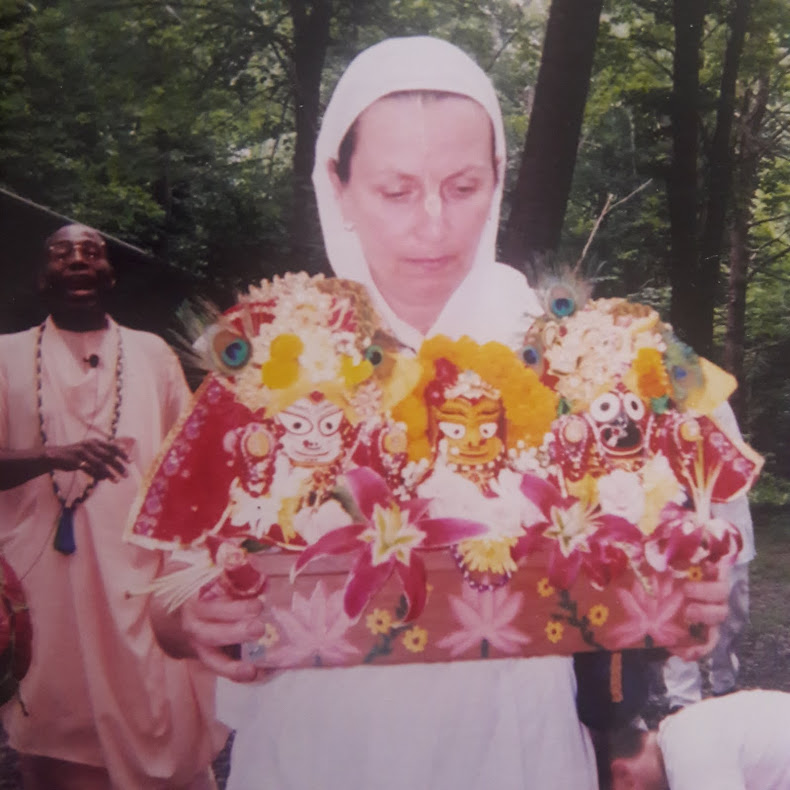
Among Śrīla Prabhupāda’s female disciples who never married or who, for whatever reasons, were bereft of husbands, some have set ideal examples, living austerely and selflessly for the service of the spiritual master and Kṛṣṇa. My godsister Gaurī Dāsī, a veteran book distributor, comes to mind as one, my godsister Kauliṇī Dāsī another. And there are others, both among Śrīla Prabhupāda’s disciples and later.
When older devotee women have no husbands, sons, or other family members to care for them the gṛhastha community should take the responsibility. For a woman to remarry goes against religious principles, but when women have no husbands and are not provided for, what should we expect? The women may be anxious to remarry, perhaps less for sex than for security.
In the Bhāgavatam (3.16.10) the Personality of Godhead says that one should see brāhmaṇas, cows, and “defenseless creatures” (bhūtāny alabdha-śaraṇāni) as nondifferent from Him. Śrīla Prabhupāda comments that according to the Manu-saṁhitā the “defenseless creatures” are cows, brāhmaṇas, women, children, and old men. So women deserve protection and support —and elderly women doubly.
A word of caution, however. Even when a woman is older, it is easy for her and a man involved in her care to fall into a romantic relationship. Precautions should be vigilantly observed to prevent this. Women should be fully engaged in activities of Kṛṣṇa consciousness, and men should not mix with them closely and should never be alone with them.22
Mothers and sons
That elderly men should strive for independence, that women should always be protected, and that women should not remarry underscores that a great responsibility rests with sons. As Śrīla Prabhupāda writes, “In the absence of the father it is the duty of the grown son to take charge of his mother and serve her to the best of his ability so that she will not feel separation from her husband.”23 But the son should not provide his mother merely psychological support; he must be ready to take charge of the full responsibility for his mother’s care. According to Śrīmad-Bhāgavatam (10.45.7), a man who is able to support his elderly parents but fails to do should be considered dead, though breathing.24 One’s father, of course, may live independently and take care of himself. So although a son has the duty to care for both parents, in particular he has the duty to see to the care of his mother.
In every Vaiṣṇava society, sons should be educated from an early age to understand this duty. They should know that when grown up they must be ready to take responsibility for their mother. Just as a mother takes care of her son when the son is a child, the grown son should take care of his mother after his father is gone.
If a woman is sonless or her son is unable (or unwilling) to take charge, the duty should be taken up by her elder brother or some other responsible family member. Or in the absence of family members the gṛhastha community should find some way to see to her protection.25
Śacīsuta Dāsa, a successful devotee entrepreneur, provided full care for Kauliṇī Dāsī, an elderly, devoted Vaiṣṇavī widow, so that in her last years she would have no anxieties over her needs. But not everyone has a Śacīsuta to look after them. So this is an item that needs attention from the gṛhastha communities in the Hare Krishna movement: providing for older members, and especially for elderly women who have given their life in service.
Notes:
1 pitā rakṣati kaumare bhartā rakṣati yauvane / rakṣanti sthāvire putrā na strī svatantryam arhati (Manu-saṁhitā 9.3). Text 5.148 gives essentially the same rule: balye pitur vaśo tīṣṭhet pāṇigṛhasya yauvane / putrāṇāṁ bhartarī prete na bhajeta svatantratām. Manu further says (5.149), pitrā bhartrā sutair vāpi necched viraham ātmanaḥ / eṣāṁ hi viraheṇa strī garhye kuryād ubhe kule: “She must never want to separate herself from her father, husband, or sons; for by separating herself from them a woman brings disgrace on both families [that of her father and that of her husband].”
2 Caitanya-śikṣāmṛta, chapter two, part four. Here Bhaktivinoda Ṭhākura adds, “Though some women, being exceptionally qualified—achieving high education, expert understanding of scripture, and great expertise—may take to the brahmacārī or sannyāsa āśrama, it is not the normal rule, as women are usually of weaker body, faith, and discriminating power.” As Śrīla Prabhupāda wrote to a female disciple, “[S]piritually everyone is equal. But materially a woman cannot be given Sannyasa. But you should not be bothered because you are serving on the spiritual platform.” (Letter to Ādityā Dāsī, February 4, 1976)
3 Bhāgavatam 4.23.20, purport. Bhakti Vikāsa Swami tells me that the proper feminine term would be vana-vāsiṇī (personal communication, January 9, 2024).
4 Bhāgavatam 4.28.44, purport.
5 Bhāgavatam 4.23.20, purport.
6 Bhāgavatam 4.23.20, purport.
7 Bhāgavatam 4.23.20, purport. A woman whose husband has accepted sannyāsa is also considered a widow. “A sannyāsī is considered to be a dead man civilly, and therefore the wife becomes a civil widow.” (Bhāgavatam 1.13.30, purport)
8 Letter to Yamunā and Dīnatāriṇī, February 21, 1976.
9 Letter to Govinda Dāsī, April 30, 1974.
10 Letter to Jayatīrtha, January 13, 1976.
11 Letter to Yamunā and Dīnatāriṇī, Jan 13, 1976.
12 Letter to Yamunā and Dīnatāriṇi, February 21, 1976.
13 Letter to Pālikā Devī Dāsī, November 13, 1975.
14 By grotesque here, Śrīla Prabhupāda apparently means something along the lines of extravagant. –js
15 Letter to Yamunā and Dīnatāriṇi, February 21, 1976.
16 “So spiritually everyone is equal. But materially woman cannot be given Sannyasa” (Letter to Ādityā Dāsī, February 4, 1976). “Woman is never offered sannyasa in the Vedic culture” (Letter to Nevatiaji, July 16, 1970). “A woman is not supposed to take sannyāsa. So-called spiritual societies concocted in modern times give sannyāsa even to women, although there is no sanction in the Vedic literature for a woman’s accepting sannyāsa. Otherwise, if it were sanctioned, Kardama Muni could have taken his wife and given her sannyāsa.” (Bhāgavatam, 3.24.40, purport)
17 “The vivid example is Visnupriya devi, Lord Caitanya’s wife. When Lord Caitanya left home accepting the renounced order of life, sannyasa, at that time Visnupriya was on the summit of youth, 16 years old, but when her husband became sannyasi she also became greater than sannyasa. . . . I think you should follow the footsteps of Srimati Visnupriya.” (Letter to Govinda Dāsī, April 30, 1974)
18 Rṇa-kartā pitā śatrur mātā ca vyabhicārinī. Lecture, June 25, 1975, Los Angeles. Garden conversation, June 14, 1976, Detroit. See also Bhāgavatam 3.23.3, purport. (Patita Pavana Dāsa writes that this verse is not found among any of the versions of Cāṇakya-nīti he came across, though it might have been included in a Sanskrit or Bengali compilation called Cāṇakya-ślokas that Śrīla Prabhupāda read as a young student. Patita Pavana Dāsa 2015, p. 391, 397.) See also the remembrance from Manmohinī Dāsī (“Son or daughter”), Memories, chapter 50.
19 Letter to Rūpānuga, August 21, 1975. On the other hand, on one occasion, in a Bhāgavatam class on June 25, 1975, Śrīla Prabhupāda said, “So in the Vedic civilization a woman, if she has no child or son or daughter, she can marry for the second time.”
20 “Confidentially” seems intended. –js
21 Transcendental Diary, Volume 3. July 19, 1976. See also Śrīla Prabhupāda’s instruction to Manmohinī Dāsī (“I was the first widow in the movement”), Memories, chapter 50.
22 mātrā svasrā duhitrā vā nāviviktāsano bhavet / balavān indriya-grāmo vidvāṁsam api karṣati
“One should not allow oneself to sit on the same seat even with one’s own mother, sister, or daughter, for the senses are so strong that even though one is very advanced in knowledge, he may be attracted by sex.” Bhāgavatam 9.19.17.
23 Bhāgavatam 3.25.5, purport.
24 After Lord Kṛṣṇa killed Kaṁsa, the Lord spoke with Devakī and Vasudeva, his natural parents, and apologized to them for not having been able to serve them while away in Vṛndāvana. In that context the Lord spoke this verse.
25 When Kuntīdevī was widowed at an early age and her sons were still children, she came under the protection of her husband’s brother Dhṛtarāṣṭra. Because of Dhṛtarāṣṭra’s spiritual blindness, Bhīṣmadeva and Vidura went to extra lengths to care for her, as did her nephew Kṛṣṇa himself.
This is part of a draft
This is an excerpt from a new book I have in the works—The Vānaprastha Adventure, a guide to retirement in spiritual life. While I’m working on it, I’ll be posting my draft here, in installments. I invite your comments, questions, and suggestions.

You must be logged in to post a comment.