
The Vānaprastha Adventure, Installment 41
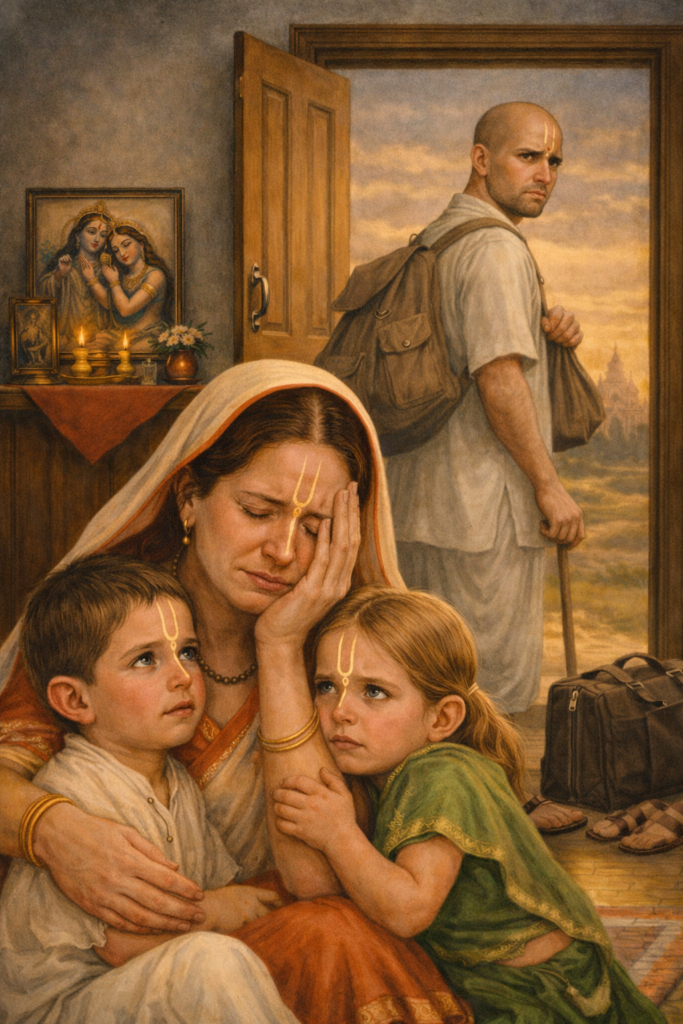
As mentioned in the main text of this book, it is fitting to retire from family life at a mature stage, but a young man should not prematurely give up family life in the name of the vānaprastha āśrama merely to avoid family responsibilities.
In this regard, a letter from Śrīla Prabhupāda to his disciple Madhukara Dāsa dated January 4, 1973, is instructive. Madhukara’s wife, Līlā-śakti Dāsī, gives the background of the letter.1
In New Dwarka [Los Angeles] in the early 1970s, it didn’t matter what we wanted or didn’t want, we did what Prabhupāda wanted. Although I wanted to devote my life to Kṛṣṇa and be done with material relationships, since Prabhupāda thought all women should be married, I agreed to get married. But I continued living in the temple and distributing Prabhupāda’s books. After a year-and-a-half, my husband, Madhukara, said to me, “Lila Shakti, I want to have a family,” and he wrote Śrīla Prabhupāda a letter saying if we weren’t going to have a child [which they later did], then he wanted to take vanaprastha. Prabhupāda wrote him a long letter back.
This is the text of that letter:
My dear Madhukara,
I beg to acknowledge receipt of your letter dated December 22, 1972, and I have noted the contents with care. For these questions arising between married husband and wife, you are requesting me to leave your wife and take the vanaprastha order of life, for these questions you must consult with and take permission from presidents and GBC. Yes, I know your wife Lilasakti, and I know that she is very serious and advanced disciple. But now you are married to her, there is some obligation according to our Krsna consciousness or Vedic system. These things cannot be taken so lightly, otherwise the whole thing will become a farce. Simply get married without considering what is the serious nature of married life, then if there is little disturbance, or if I do not like my wife or my husband, let me go away, everyone else is doing like that. So in this way the whole thing is becoming a farce. You say that your “association together was hindering your advancement.” But Krsna consciousness marriage system should not be taken in that way, that if there is any botheration that means something is hindering my spiritual progress, no. Once it is adopted, the grhastha life, even it may be troublesome at times, it must be fulfilled as my occupational duty. Of course, it is better to remain unmarried, celibate. But so many women are coming, we cannot reject them. If someone comes to Krsna it is our duty to give them protection. Krsna has informed us in Bhagavad-gita that even women and sudras and others inferior class of men can take refuge in Him. So the problem is there, the women must have a husband to give protection. Of course, if the women can remain unmarried, and if there is suitable arrangement for the temple to protect them, just like in the Christian Church there is nunnery for systematic program of engaging the ladies and protecting them, that is also nice. But if there is sex desire, how to control it? Women are normally very lusty, more lusty than men, and they are weaker sex, it is difficult for them to make spiritual advancement without the help of husband. For so many reasons, our women must have husband. That’s all right, but if once they have got a husband he goes away so quickly, that will not be very much happy for them.
Now I do not know the situation in your particular case, I am simply giving you the general policy or background understanding. We should never think of our so-called advancement as being conditioned by or dependent upon some set of material circumstances such as marriage, vanaprastha, or this or that. Mature understanding of Krsna consciousness means that whatever condition of life I am in at present, that is Krsna’s special mercy upon me, therefore let me take advantage in the best way possible to spread this Krsna consciousness movement and conduct my spiritual master’s mission. If I consider my own personal progress or happiness or any other thing personal, that is material consideration. If there was unhappy adjustment for becoming married, why you got married at all? Whatever is done, is done, that is a fact, but I am only pointing out that once before you did something without proper study of your real responsibility, now you are contemplating again some drastic action in a similar manner. Therefore consider it carefully in this light. There is one verse from Bhagavad-gita: yasman nodvijate loko lokan nodvijate ca yah/harsamarsa-bhayodvegair mukto yah sa ca me priyah, “He for whom no one is put into difficulty and who is not disturbed by anxiety, who is steady in happiness and distress, is very dear to Me.” (12.15) One mistake of judgment often made by the neophyte devotees is that any time there is some disturbance or some difficulty they are considering that the conditions or the external circumstances under which the difficulty took place are the cause of the difficulty itself. That is not the fact. In this material world there is always some difficulty, no matter in this situation or that situation. Therefore simply by changing my status of occupation or my status of life, that will not help anything. Because the real fact is that if there is any difficulty with others, that is my lack of Krsna consciousness, not theirs. Is this clear? Krsna says that His dearest devotee is one who does not put others into difficulty, in fact, who puts no one other into difficulty. So try to judge the matter on these points, whether or not you are putting either your wife or yourself into some difficulty. The right understanding of Bhagavad-gita is Arjuna’s understanding. In other words, Arjuna came to the conclusion that he must perform his occupational duty, not as a material obligation, for reasons of wife, family, friends, reputation, professional integrity, like that—no. Rather he must conduct the functions of his station of life only as a devotional service performed for Krsna. That means that devotional service is what is important, not my occupational duty. But it does not mean that because occupation duty is not the real consideration, that I should give it up and do something else, thinking that devotional service may be carried on under whatever circumstances which I may whimsically decide. Krsna recommended Arjuna to remain as he was, not to disrupt the order of society and go against his own nature just for convenience sake. Our occupational duty is not arbitrary, that means once we have taken up some field of action, if we are advanced in our understanding, then we shall not change it for another. Rather our devotion is the important factor, so what does it matter what I am doing so long my work and energy are completely devoted to Krsna? Just like Krsna, He is the Supreme Personality of Godhead, He has no work, neither He has anything to do, still He comes here to teach us this lesson. He accepts not only His occupational duty as cowherd boy, royal prince, but also He accepts married life, He enters politics, He is philosopher, He is even chariot driver during a great battle, He does not give example of Himself avoiding His occupational duty. So if Krsna Himself is exhibiting by His own conduct what is the perfection of existence, then we should heed such example if we are intelligent. Even supposing there is wife at home, with children, that does not matter, that is no hindrance to our spiritual life. And once we have accepted these things, occupational duties, we should not lightly give them up. That is the point. Of course, our occupational duty is as preachers of Krsna consciousness. So we must stick to that business under all circumstances, that is the main thing. Therefore married, unmarried, divorced, whatever condition of life, my preaching mission does not depend on these things. The varnasrama-dharma system is scientifically arranged by Krsna to provide facility for delivering the fallen souls back to home, back to Godhead. And if we make a mockery of this system by whimsically disrupting the order, that we must consider. That will not be a very good example if so many young boys and girls so casually become married and then go away from each other, and the wife is little unhappy, the husband is neglecting her in so many ways, like that. If we set this example, then how the thing will go on properly?
Householder life means wife, children, home, these things are understood by everyone, why our devotees have taken it as something different? They simply have some sex desire, get themselves married, and when the matter does not fulfill their expectations, immediately there is separation—these things are just like material activities, prostitution. The wife is left without husband, and sometimes there is child to be raised, in so many ways the proposition that you, and some others also, are making becomes distasteful. We cannot expect that our temples will become places of shelter for so many widows and rejected wives, that will be a great burden and we shall become the laughingstock in the society. There will be unwanted progeny also. And there will be illicit sex life, that we are seeing already. And being the weaker sex, women require to have a husband who is strong in Krsna consciousness so that they may take advantage and make progress by sticking tightly to his feet. If their husband goes away from them, what will they do? So many instances are already there in our Society, so many frustrated girls and boys.
So I have introduced this marriage system in your Western countries because there is custom of freely intermingling male and female. Therefore marriage required just to engage the boys and girls in devotional service, never mind distinction of living status. But our marriage system is little different than in your country, we do not sanction the policy of quick divorce. We are supposed to take husband or wife as eternal companion or assistant in Krsna consciousness service, and there is promise never to separate. Of course if there is any instance of very advanced disciples, married couple, and they have agreed that the husband shall now take sannyasa or renounced order of life, being mutually very happy by that arrangement, then there is ground for such separation. But even in those cases there is no question of separation, the husband, even he is sannyasa, he must be certain his wife will be taken care of nicely and protected in his absence. Now so many cases are there of unhappiness by the wife who has been abandoned by her husband against her wishes. So how can I sanction such thing? I want to avoid setting any bad example for future generations, therefore I am so much cautiously considering your request. But if it becomes so easy for me to get married and then leave my wife, under excuse of married life being an impediment to my own spiritual progress, that will not be very good at all. That is misunderstanding of what is advancement in spiritual life. Occupational duty must be there, either this one or that one, but once I am engaged in something occupational duty, then I should not change that or give it up, that is the worst mistake. Devotional service is not bound up by such designations. Therefore once I have chosen, it is better to stick in that way and develop my devotional attitude into full-blown love of Godhead. That is Arjuna’s understanding.
Hoping this meets you in good health,
Your ever well-wisher,
A. C. Bhaktivedanta Swami
Notes:
1 As quoted in Mālatī Devī Dāsī, A Bond of Love, p. 279.
This is part of a draft
This is an excerpt from a new book I have in the works—The Vānaprastha Adventure, a guide to retirement in spiritual life. The book should be published in early 2026. Meanwhile I’ll be posting my draft here, in installments.

You must be logged in to post a comment.